
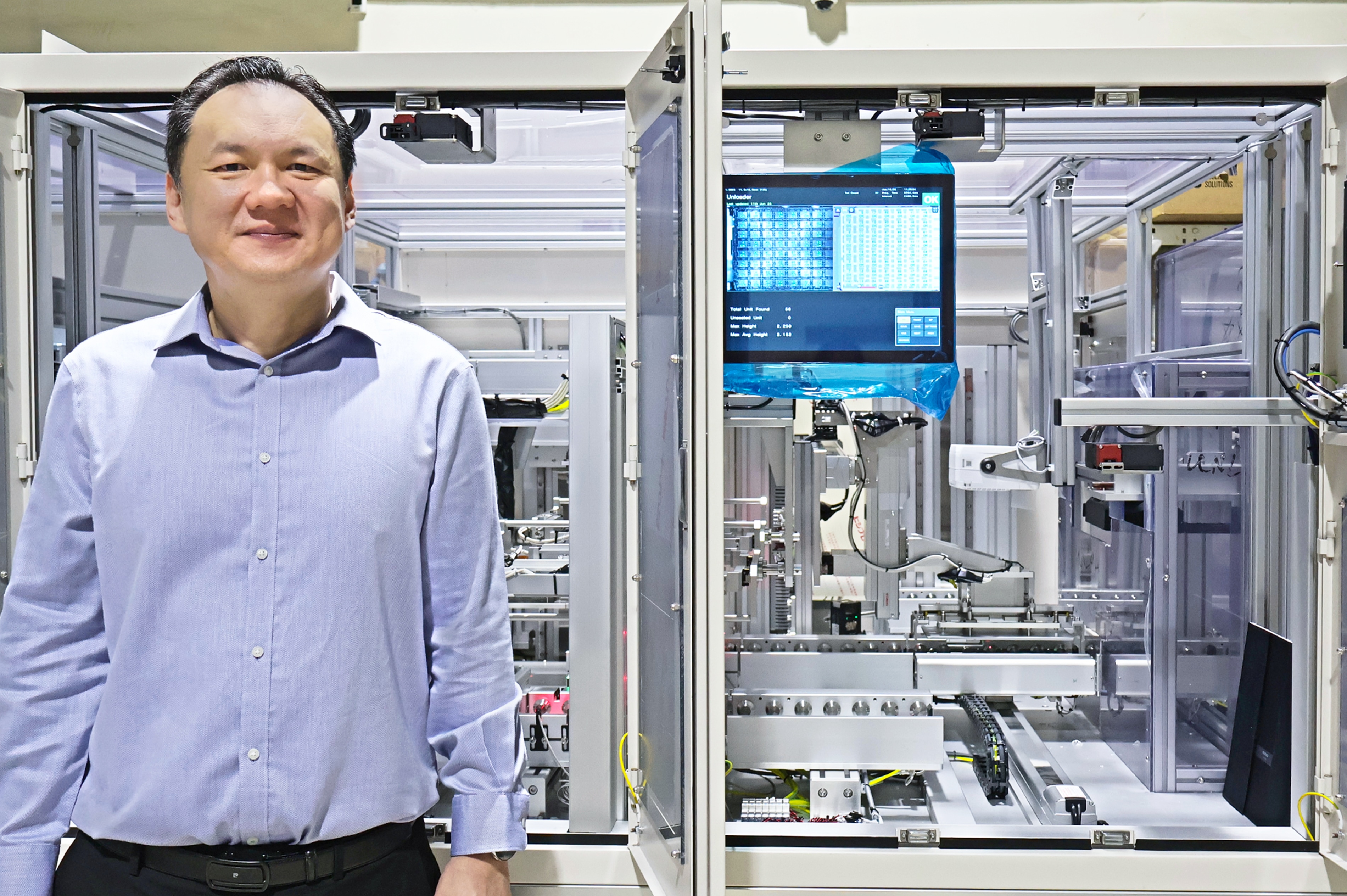
Inventit designs and builds custom automation equipment in Singapore for the hard disk drive media and solid-state memory industries. On a machine that loads and unloads material around a reflow oven for a semiconductor manufacturer, 2D vision could not tell whether a 1 mm thick IC package was truly seated in its tray pocket, and 40 to 50% of those defects went undetected. By retrofitting pattern projection lighting (a structured-light 3D technique) on the KEYENCE XG-X Series vision system, which fits in about the same space as the 2D camera it replaced, Inventit reached the 95% detection level its customer had specified and freed two operators from continuous monitoring.

Summary of this case
- Inventit, a Singapore machine builder, builds custom automation machines that are not available off the shelf, mainly for the hard disk drive media and solid-state memory industries.
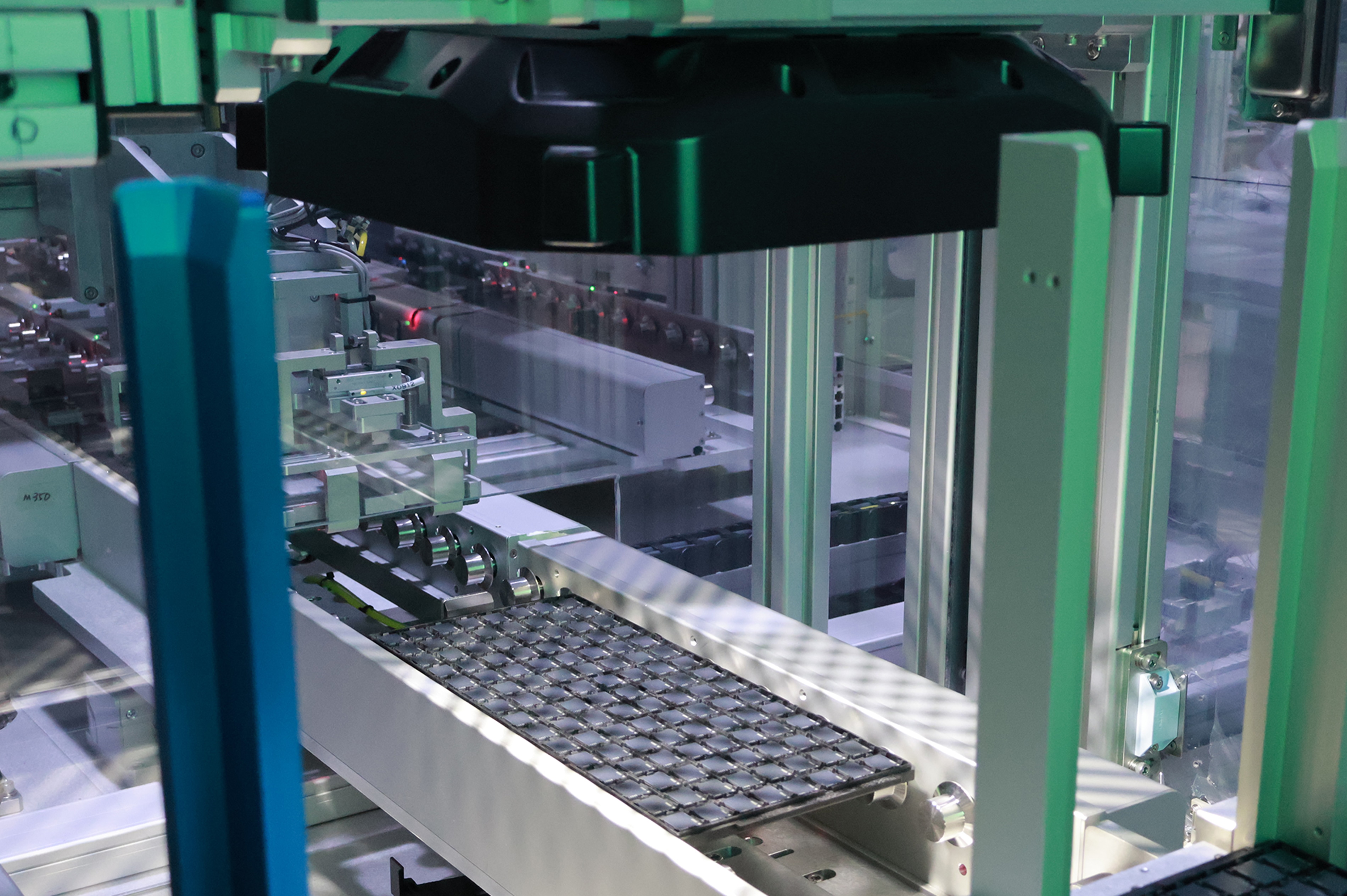
- For a semiconductor manufacturer, Inventit built a machine that transfers IC packages about 1 mm thick between JEDEC trays and reflow trays around a reflow oven, stacking the trays and flipping them 180 degrees.
- 2D vision could not judge whether a package was seated in its tray pocket, and 40 to 50% of seating defects escaped detection.
- A 3D line scanner needed more installation space than the already-delivered machine had. Pattern projection lighting for the KEYENCE XG-X Series fits in about the same space as the 2D camera, so it could be retrofitted.
- Detection reached about 95%, the level the end customer had specified. Inventit attributes the remaining margin to normal variation in the trays and units, not to the vision system.
- Each check takes about 4 to 5 seconds instead of about 1 second, but inspection was not the bottleneck, so the machine still meets its 25 seconds per tray.
- Two operators are no longer needed to monitor every transfer; operators only load and unload material.
- Since the first project, Inventit has applied pattern projection to other machines, where one camera now does the work of several sensors.
ApplicationWhat does this machine do, and where does inspection fit in?
The machine automates the loading and unloading of a reflow oven for a semiconductor manufacturer that had been doing it by hand — time-consuming, labour-intensive, and costly. Inventit studied the manual process and proposed automating the whole sequence: transfer the units from a JEDEC tray to a reflow tray, pass them through the reflow oven, then transfer them back from the reflow tray to a JEDEC tray. The trays are stacked one on top of the other and flipped 180 degrees to move the units across. The system inspects at three stations: seatedness before the flip, count after the flip to confirm nothing was dropped, and count plus seatedness again after reflow, before unloading. The end customer runs up to about 30 different package types, from 5 mm by 5 mm to 15 mm by 15 mm, with a recipe change at every size changeover.
Inventit itself builds automation machines that are not available off the shelf, customised to each customer’s requirements. Its work is concentrated in the hard disk drive media and solid-state memory industries, where much of the equipment is standard but not connected to anything else, so a large part of what Inventit builds is the material handling and transport that links those standalone processes together, by conveyor or by AGV.
"Many of these processes in hard disk drive have standard equipment, but they do not integrate with each other. So what we do is link up all the machines together, either through a conveyor system, or AGV nowadays, to transport the material from one process to another."
In the solid-state memory field, though, much of the work involves customised tooling that is part of the assembly process itself — checking a part before or after it is assembled — rather than just moving material between machines. That is usually where vision inspection becomes necessary.
ChallengeWhy can't 2D vision tell whether a 1 mm IC package is seated?
Because the trays are stacked and flipped, seating is a safety-critical condition rather than a cosmetic one: if a chip is not sitting properly in its pocket, the tray placed on top of it will damage the unit, and at about 1 mm thick the packages tolerate very little force. The inspection was originally built around 2D imaging, and that is where the difficulty began. A tray pocket has depth, and a 2D camera sees only X and Y from above. A package tilted slightly inside its pocket looks much the same as one lying flat, so 2D imaging cannot judge seating reliably unless the package is completely out of the pocket. Inventit puts the escape rate at roughly 40 to 50% of the seating defects.
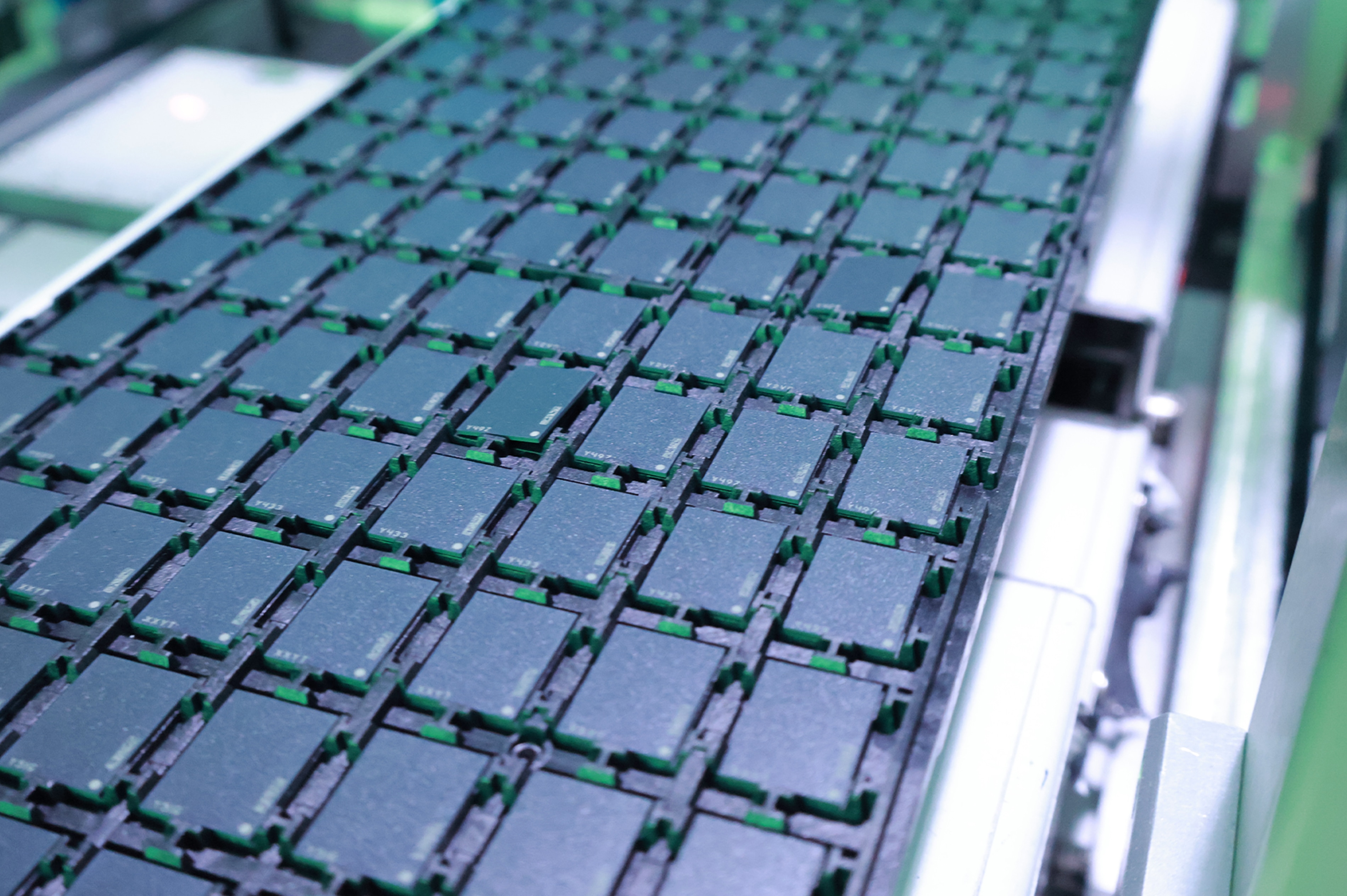
"The units are only about 1 mm thickness. So a slight tilt inside the pocket, from a 2D perspective, cannot tell that it's actually seated correctly or not — unless the unit is totally out of the pocket. That's why we were facing a very high failure rate."
SelectionWhy Pattern Projection Lighting on the XG-X Series rather than a 3D line scanner?
One alternative was on the table: a 3D line-scan laser that plots a 3D image of the tray. The end customer suggested it, and a supplier known to Inventit had already implemented it. Technically it would have worked, but a line scanner has to travel the length of the tray to build up that image, and it therefore needs a large installation envelope. The machine had already been designed, manufactured and delivered; the only space available was the space that had been allocated to the 2D camera. Pattern projection lighting for the KEYENCE XG-X Series was launched in Singapore at almost exactly that moment, and because it needs about the same space as a 2D camera, it was the one option that could be fitted to the machine as built. KEYENCE had been involved in the original 2D inspection and stayed with the project while the alternatives were being weighed.
"Using a line scan, it requires a big space to implement this application, because the scanner has to move along the tray to scan the whole tray. But at that time we had already delivered and manufactured this machine, so space was something that we could not afford at that moment. The pattern projection needed a similar space to the 2D vision. That's why it was the best option that we had at that time."
ResultsFrom a 40 to 50% miss rate to 95% detection
Inspection using pattern projection lighting captures height in addition to position, which is precisely what the application had been missing. Detection of seating defects went from the 40 to 50% escape rate of the 2D setup to about 95% — the figure the end customer had specified. Inventit attributes the remaining margin not to the vision system but to normal variation in the trays and in the units themselves. Cycle time was not compromised: pattern projection takes around 4 to 5 seconds against about a second for the earlier 2D check, but inspection was never the bottleneck, so the machine still meets its requirement of 25 seconds per tray. The clearest change on the floor was in human intervention. To keep production going while the inspection problem was open, the end customer had posted one operator at the front of the machine and one at the back to watch every transfer and catch damage. After the retrofit, that monitoring stopped; operators load and unload material and nothing more.
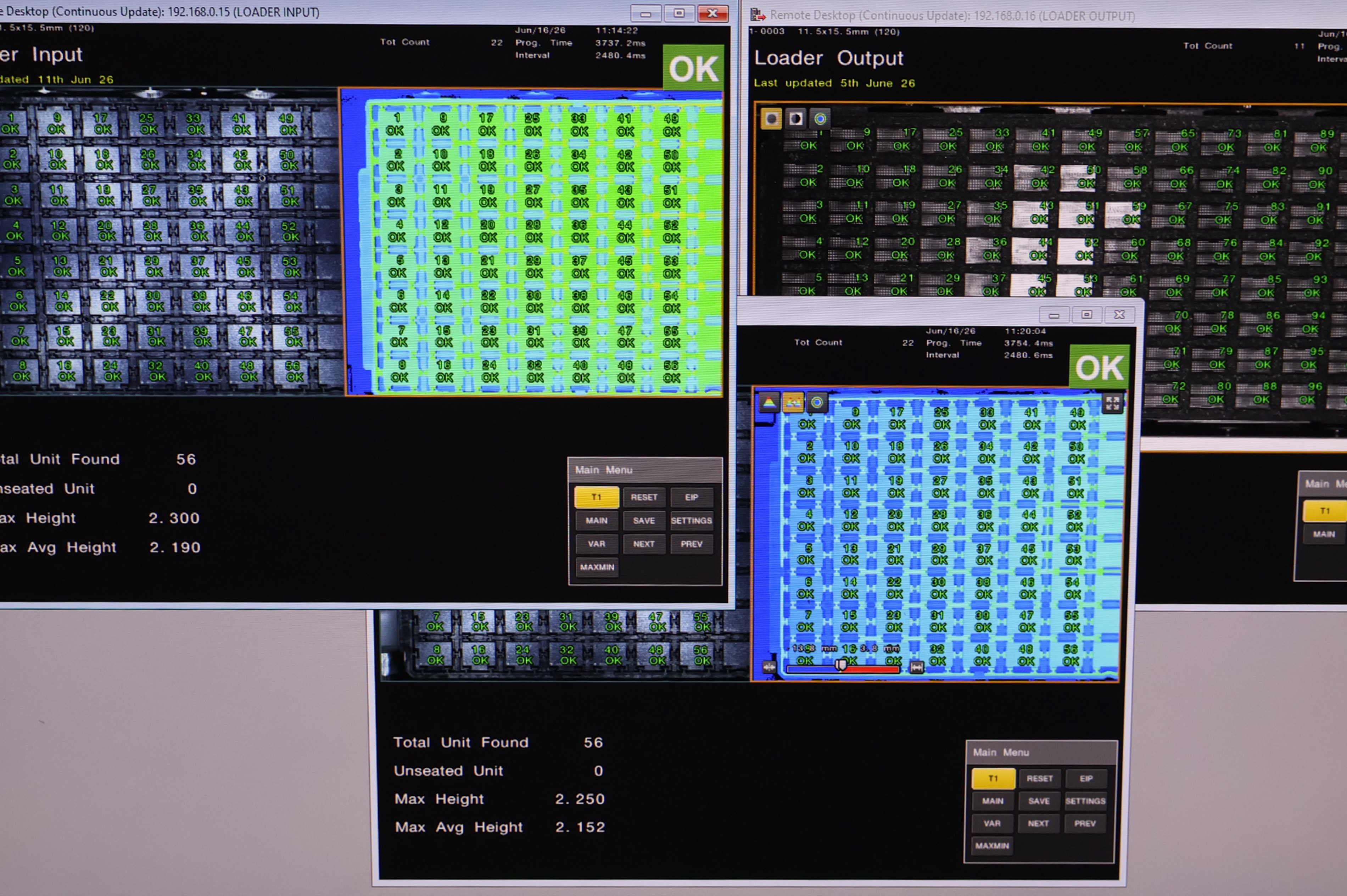
"The 2D actually had about 40 to 50% failure. So after introducing this, it improves to like 95%. Of course there will still be 5%, but not because of the vision — basically because the product has variation. In general it meets what the requirement or the specification the customer gave us, which is 95%."
OutlookHow Pattern Projection is simplifying new machine designs
Since that first project around 2017, pattern projection has been applied to other machines, including semi-automatic cells that run many different products. Those machines change nests at every product changeover, and each nest used to need a set of sensors to check presence, orientation and whether the operator had seated the part correctly. Now one camera checks all of it — presence, orientation, seating, and even whether the correct part has been loaded into the nest — which takes a great deal of complexity out of the mechanical design. Asked what he would tell another machine builder facing a similar inspection problem, Mr. Chua's answer was three words long.
"Approach KEYENCE first. When we have a problem, or a challenge that the customer brings to us, we need to partner with a company like KEYENCE to work closely with us until we can give a good solution to the customer. With the knowledge of the salespeople and the range of products that KEYENCE has, I think it's a very good partnership."

Frequently asked questions
Q How do you check whether IC packages are seated correctly in a JEDEC tray pocket?
A
A tray pocket has depth, and the IC packages Inventit handles are only about 1 mm thick. Seen from directly above, a package tilted slightly inside the pocket looks the same as a correctly seated one, so 2D X-Y imaging cannot judge it unless the package is completely out of the pocket. Inspection using pattern projection lighting on the KEYENCE XG-X Series vision system captures height as well as position, so a package that is not sitting flat in the pocket is detected.
Q How much did detection improve after Inventit introduced the KEYENCE XG-X Series?
A
With 2D inspection, roughly 40 to 50% of the seating defects were not captured. After pattern projection lighting was introduced, detection reached about 95%, which was the level the end customer had specified. Inventit attributes the remaining margin to normal variation in the trays and in the packages themselves rather than to the vision system.
Q Which 3D inspection fits an existing machine with limited space: a 3D line scanner or pattern projection?
A
Pattern projection lighting on the KEYENCE XG-X Series vision system, because it works within about the same footprint as a 2D camera. A 3D line scanner has to travel along the tray to build up the image, so it needs a large installation envelope. Inventit’s machine had already been built and delivered to the customer’s site, with only the space allocated to the original 2D camera available, which made pattern projection the best option at that stage.
Q Does 3D inspection with pattern projection lighting slow down machine cycle time?
A
The specified cycle time was 25 seconds per tray. A 2D inspection takes about one second or less, while inspection using pattern projection lighting on the KEYENCE XG-X Series takes roughly 4 to 5 seconds. Because inspection was not the bottleneck of the overall sequence, the machine still meets the 25 seconds per tray requirement.
Q How did the KEYENCE XG-X Series reduce operator workload on this machine?
A
Before the retrofit, the end customer had to station an operator at the infeed and another at the outfeed to watch the transfer and prevent damage to the packages. Once pattern projection was in place, that monitoring was no longer needed and operators only load and unload material.
Q What other applications has Inventit built using the KEYENCE XG-X Series with Pattern Projection Lighting?
A
Inventit has applied pattern projection to semi-automatic machines that run many different products. Where several sensors used to be needed to check presence, orientation and correct seating in the nest, a single camera now checks all of it, including whether the right part has been loaded. That simplifies the machine design considerably.