
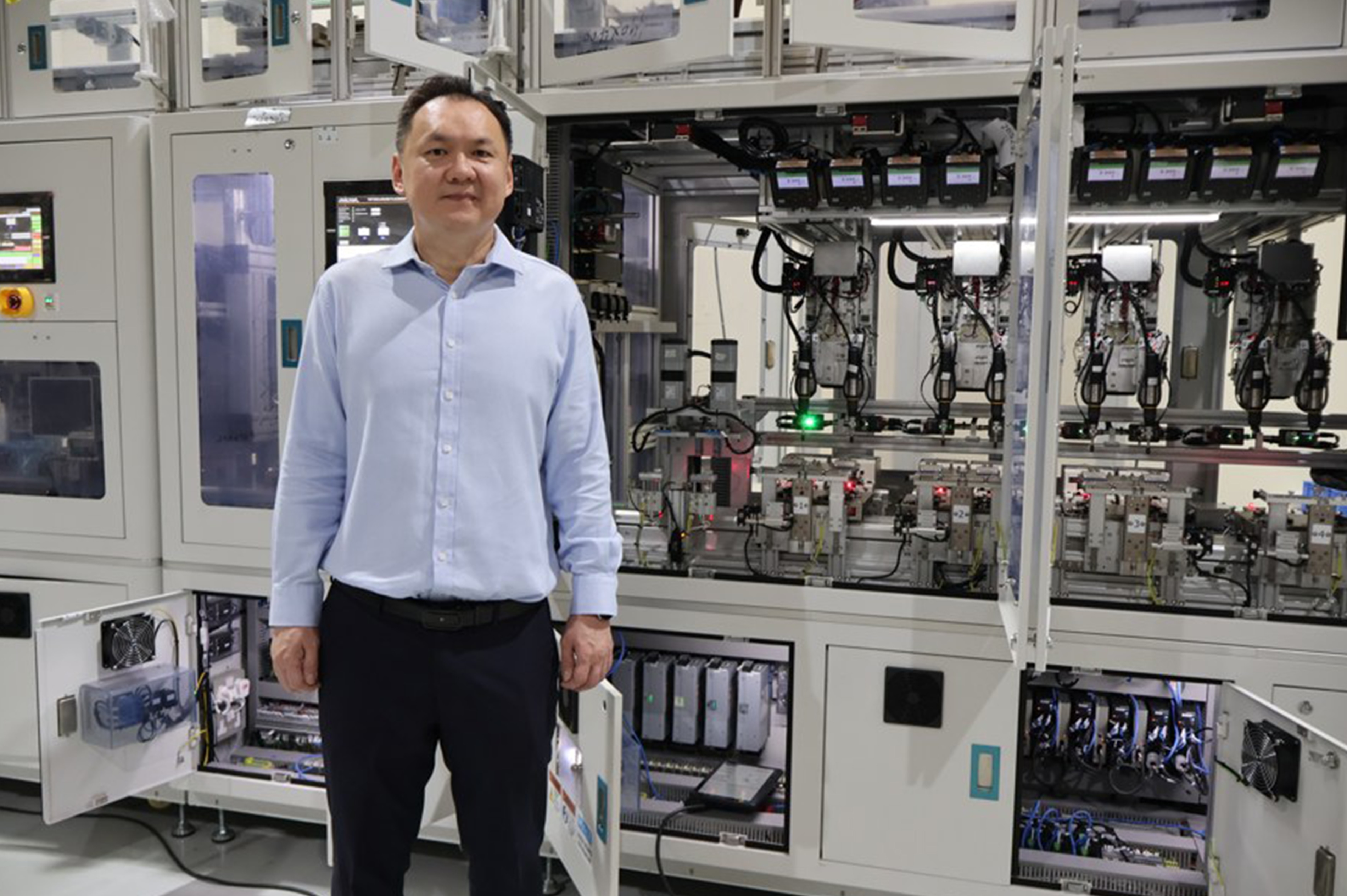
Inventit designs and builds customised automation equipment in Singapore, currently focused on the semiconductor and hard disk drive media industries. Its latest line assembles solid-state drives across nine processes — pick and place, glue dispensing, screw fastening and final vision inspection — with each pallet carrying two drives from station to station. Because the end customer runs several drive models on the same line, almost every mechanical part that touches the product is swapped at changeover. KEYENCE products cover each step: an IV4 Series vision sensor checks that each pallet is intact, barcode readers confirm that the right tool has been loaded, and AP-N Series pressure sensors carry a different vacuum threshold for each recipe.
Summary
- Inventit is a Singapore machine builder specialising in customised automation for the semiconductor and hard disk drive media industries.
- Its solid-state drive assembly line runs nine processes, with each pallet carrying two drives through the whole sequence.
- A KEYENCE IV4 Series vision sensor performs a health check on every pallet — a single unit replaces the many individual sensors previously needed to cover multiple product types.
- KEYENCE code readers on one machine, and more than 50 across the line, read the 2D codes on screwdriver heads, top plates, screw feeders, pallets and drives to prevent the wrong tool from being run.
- AP-N Series pressure sensors communicate with the PLC over EtherNet/IP, so the vacuum threshold for screw pick-up changes automatically with the recipe instead of being reset by hand at every changeover.
- After the line moved from roller conveyors to linear servo transport for higher throughput, the KEYENCE devices still keep up with the line speed.
- Inventit has used the IV Series since its first generation and switched to KEYENCE code readers more than 15 years ago, citing short lead times and responsive support as the deciding factors.
CHALLENGEThe challenge: multiple models on one line, and no room for the wrong tool
Inventit builds machines to order, designed to each customer's specification. Most of those customers ask for the same thing: one machine that can run several product models.
On the current solid-state drive project, that means the screwdriver pickup heads, the top plates that hold each drive in position, and the screw feeders are all swapped when the line changes model. Each variant uses a different screw size, a different number of screws, or screws in different positions. If an operator loads the wrong head or the wrong plate, the error surfaces downstream — in the product.
Pallets pose a second, quieter risk. Each pallet is assembled from many parts and recirculates continuously through all nine processes, so parts work loose or get damaged over time.
"Most of our customers want to be able to run multiple products in our machine. One product is easy, but when we start to implement different product types and models, that's where the challenges came."
Covering all of that with individual sensors was impractical. Height and presence detection alone would have required a large number of units per station, and every added model multiplied the count.
SELECTIONWhy KEYENCE: from the first IV sensor to recipe-driven pressure monitoring
The company's history with KEYENCE vision sensors goes back roughly a decade, to the launch of the first-generation IV sensor. Before that, the alternatives were a bank of individual sensors — difficult to manage across models — or a full vision system, which end customers considered too costly for the task.
"To use sensors is very difficult for us to manage, and to use a vision system the customer finds too costly. So the vision sensor is in between, which suits. Just one unit is able to detect it, instead of many different sensors."
The move to KEYENCE code readers happened even earlier, more than 15 years ago. The readers in use before that took as long as two to three months to arrive, and technical support was hard to obtain once a problem appeared. A later capability sealed the preference: multiple banks, which let a reader hold several stored variations of the same 2D code — printed label, engraving or laser mark — and compare a read against all of them.
"Whenever the customer introduces a new model with a different type of 2D code, all we need to do is just teach this new label. If I remember correctly, it can store up to 16 different banks. That was very useful."
Screws are picked up by vacuum, and the pick-up is confirmed by monitoring pressure — but different screws give different readings. The sensor previously fitted held a single setting, so it had to be adjusted by hand at every model change. The KEYENCE AP-N Series communicates with the line's PLC over EtherNet/IP, which allowed the team to attach a pressure value to each recipe.
"That was very good, because by recipe we can set the different pressure value for different recipes."
RESULTSOn the line today: every pallet checked, every tool verified
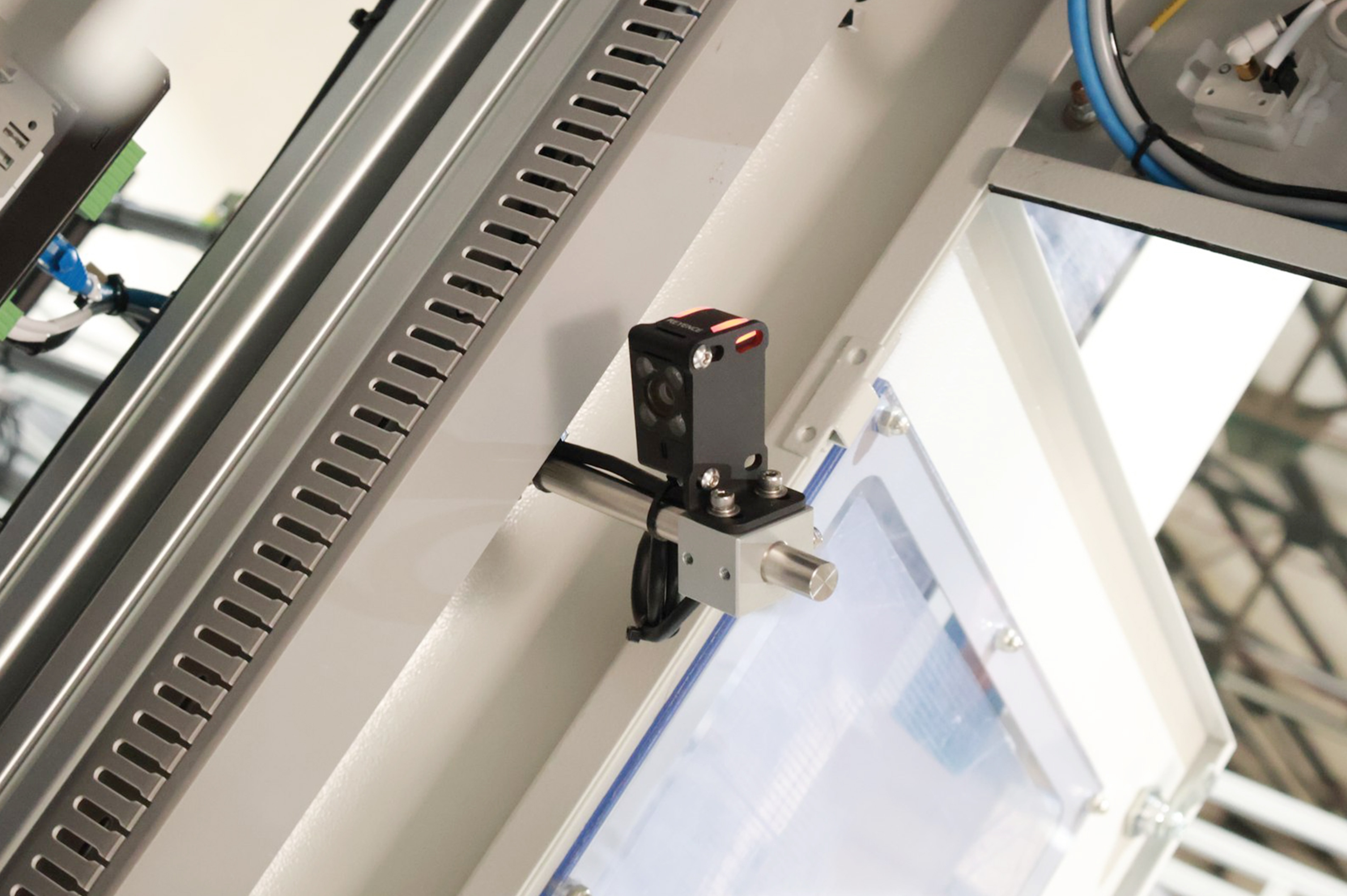
At the head of the line, the IV4 Series vision sensor inspects each incoming pallet for missing or damaged parts before any product is loaded onto it — a health check that a recirculating pallet needs and that no single-point sensor could cover.
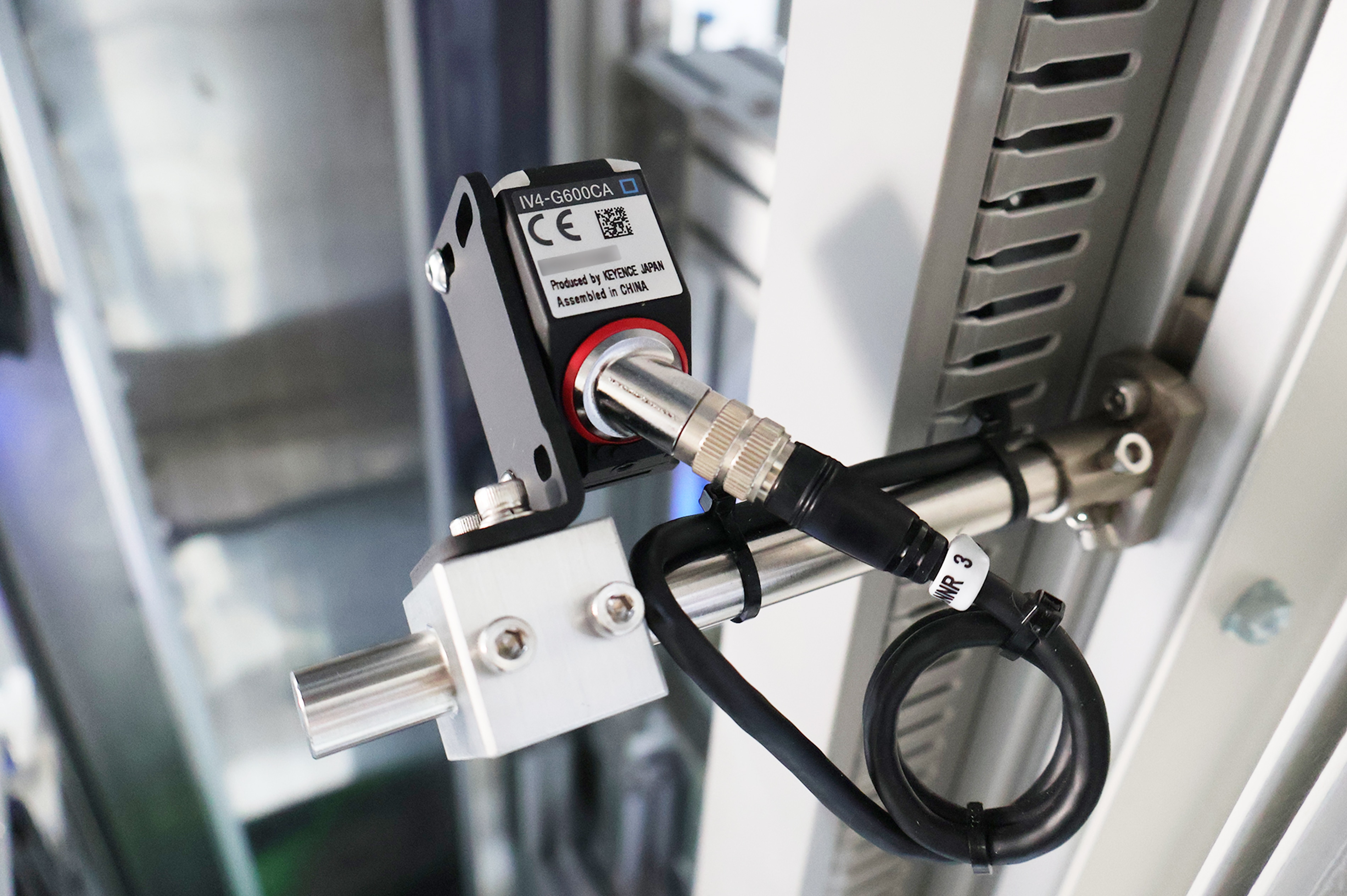
At the screw fastening station, error-proofing is handled entirely by 2D code reading. Code readers check every screwdriver pickup head, every top plate and the screw feeder. Reading distance decides which model goes where: one model for closer range, another where the code sits further away. A longer-range reader handles a combined read of two drive IDs and the pallet ID as the pallet enters the process.
"It's like error-proofing, to ensure that the user actually loads the correct tool before running the machine."
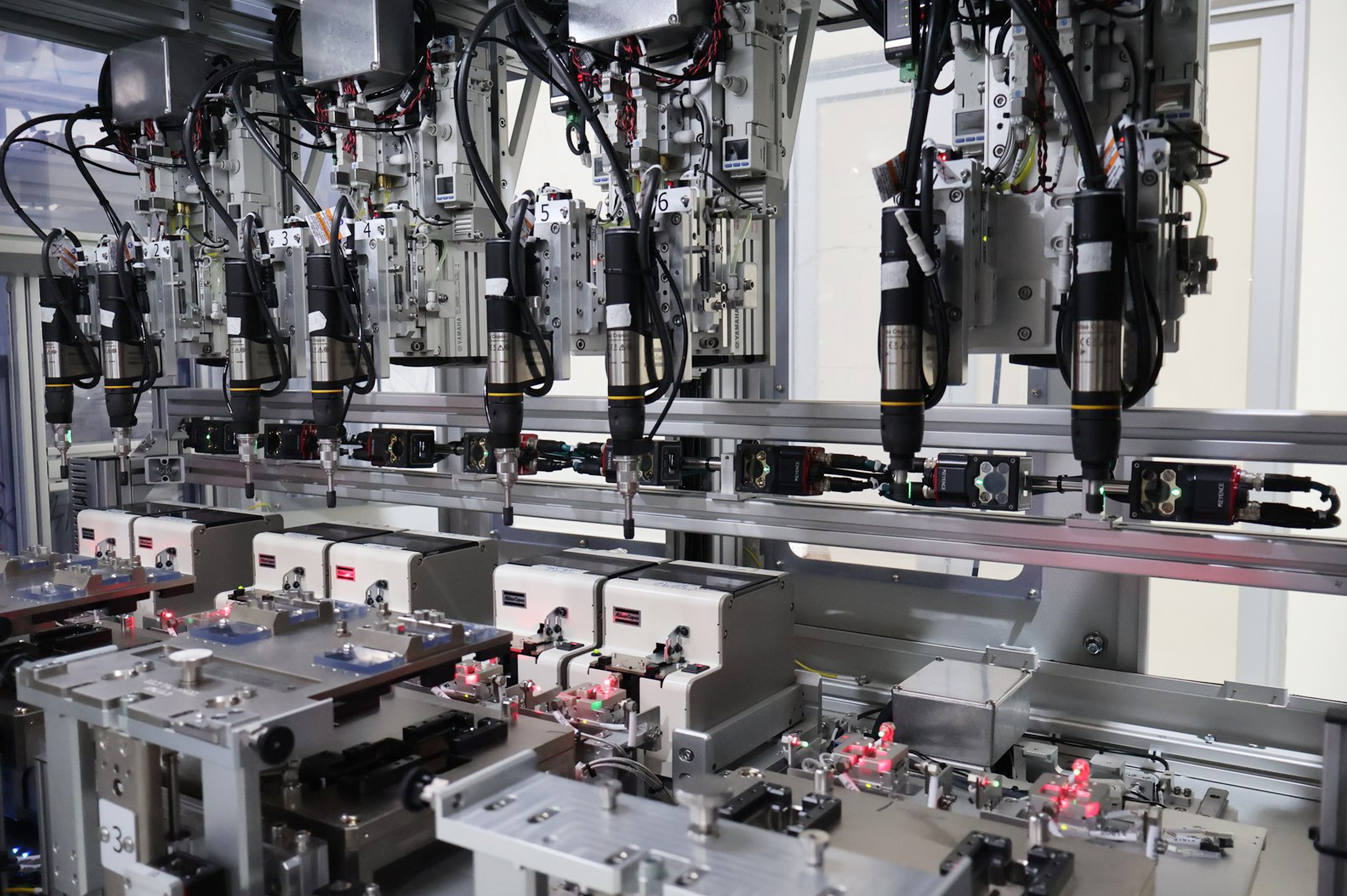
The current line is the first of a new generation for this end customer, built for higher throughput. Roller conveyors were replaced with linear servo transport to move pallets between processes — a change that raised the speed every sensor on the line has to work at.
"Even though we increased this throughput, the speed that the KEYENCE product can achieve still meets what we needed."
Lead time turned out to matter as much as performance.
"In one machine we have many other components, but KEYENCE is the only one that we don't have to worry about the lead time. That's why our priority is always to select KEYENCE."
Support has followed the same pattern. Project schedules shift constantly as end customers ask for earlier delivery, and the team credits KEYENCE engineers with accommodating those changes and being on site when the machine is being tested.
OUTLOOKLooking ahead: reliability over initial savings
For this line, Inventit stayed with 2D codes and with the readers the team already knows. Familiarity is part of that decision: switching brands would mean a learning curve with no guarantee that the result meets the requirement.
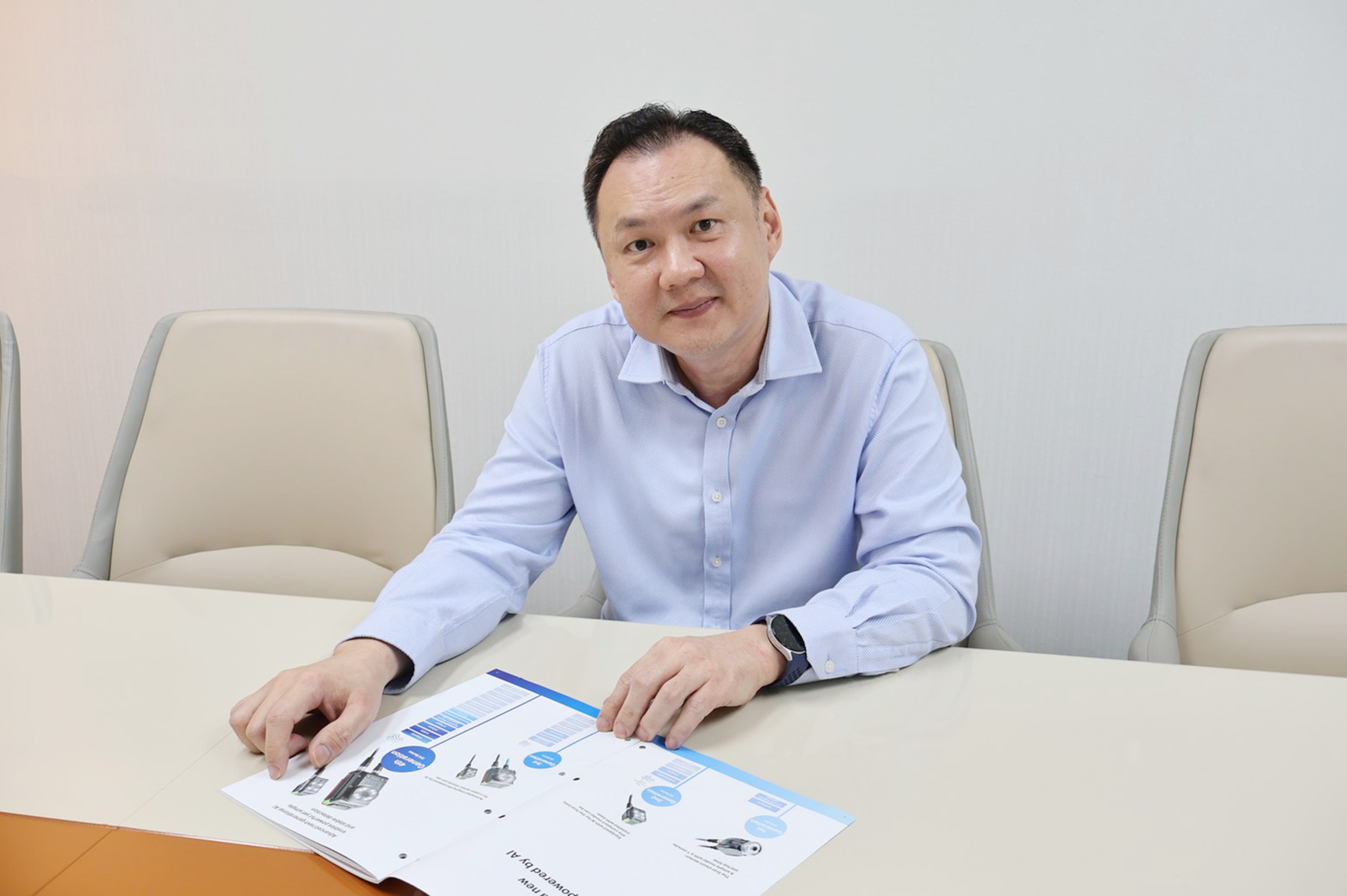
Asked what advice he would give other machine builders, Mr. Calvin Chua returns to the pressure every builder faces on price.
"There's always price pressure from the customer. We may have some savings in the beginning, but because of the issues that require us to constantly go in and rectify them, it will probably cost us more than what we saved. So I would advise going with a reliable product like KEYENCE."
Frequently Asked Questions
Q What does Inventit Technology use the KEYENCE IV4 Series vision sensor for on its solid-state drive assembly line?
A
A pallet health check. It performs a health check on every pallet entering the line. Each pallet is built from many parts and is recirculated through all nine processes, so the IV4 Series vision sensor checks for missing or damaged parts before the pallet is loaded with product.
Q Why use a vision sensor instead of individual sensors or a vision system?
A
A vision sensor sits between the two. Individual sensors were hard to manage across several product models, and a full vision system was too costly for the task, so a KEYENCE IV Series vision sensor does the checking that would otherwise need many separate sensors.
Q How do code readers stop the wrong tool being loaded at a model changeover?
A
Every changeable tool carries a 2D code, and a KEYENCE code reader checks it before the machine starts. The screw fastening station alone runs eight several screwdrivers, four top plates and separate screw feeders, and each of those tools carries a 2D code. Every tool is read at changeover so the machine can confirm the correct part has been loaded before it starts.
Q Why did Inventit Technology switch to KEYENCE code readers more than 15 years ago?
A
Lead time and support. Readers from other brands sometimes took two to three months to deliver, and technical support was difficult to obtain when problems occurred. KEYENCE readers were available quickly and came with support the team could rely on.
Q How does the multi-bank teaching function of KEYENCE code readers handle new 2D code variations?
A
The reader stores several versions of the same code and checks each read against all of them. The same 2D code can arrive as a printed label, an engraving or a laser mark. Multiple banks let the reader store those variations — up to 16 by the customer's recollection — so when an end customer introduces a new model, the team simply teaches the new code instead of reworking the setup.
Q What made the KEYENCE AP-N Series pressure sensor a better fit than the previously used pressure sensor?
A
It changes its vacuum threshold automatically with each recipe. Screws are picked up by vacuum, and different screws give different pressure readings. The previous sensor held only one setting, so it had to be adjusted by hand at every model changeover. The AP-N Series communicates with the PLC over EtherNet/IP, so each recipe carries its own pressure threshold.
Q Can the KEYENCE IV4 Series and code readers keep up after a line is upgraded to linear servo transport?
A
Yes. The latest generation of the line replaced roller conveyors with linear servo transport to raise throughput, and the customer reports that the KEYENCE devices still meet the speed the line requires.